
The Two Conflicting Pricing Philosophies
When choosing helpdesk software, buyers typically spend weeks comparing features—macros, collision detection, SLA timers, and reporting widgets. Yet the single factor that will determine your long-term satisfaction and software spend isn't a feature toggle: it is the vendor's underlying pricing unit.
In the helpdesk market, two fundamentally opposing pricing models exist:
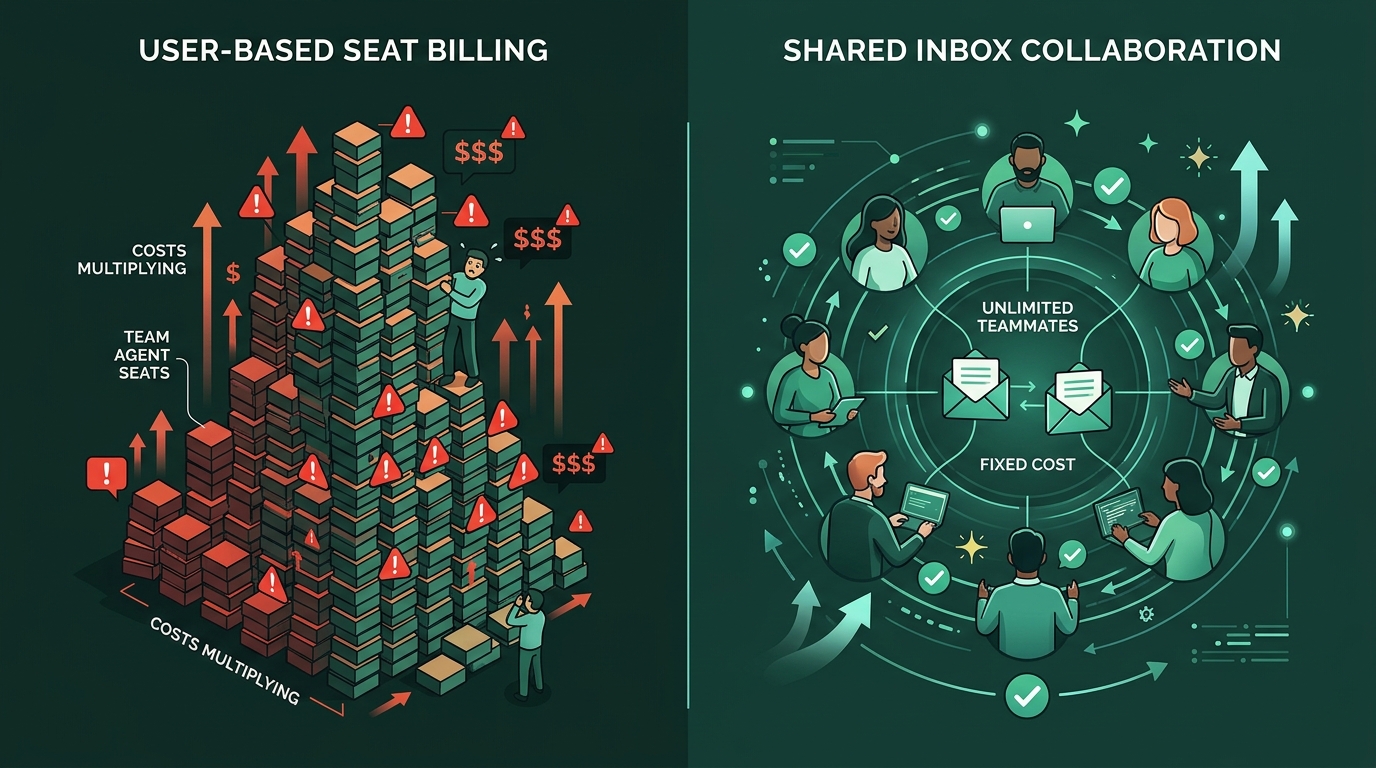
- Per-Agent (Seat-Based) Pricing: You pay a recurring fee for each human user who logs into the helpdesk (e.g., $25 to $89 per agent per month).
- Per-Inbox (Resource-Based) Pricing: You pay a fixed fee based on the number of email inboxes you connect (e.g., $9 to $65 per month for 3 to 30 inboxes), while agent seats are completely unlimited and free.
Neither model is universally superior in every circumstance. The right choice depends entirely on how your organization is structured: does your business grow faster in team members or in connected brand inboxes?
Understanding Per-Agent (Per-Seat) Pricing
Per-agent pricing has been the standard model for legacy vendors like Zendesk, Freshdesk, and Intercom since the early 2000s. It was designed around a very specific customer: the centralized enterprise call center.
When Per-Agent Pricing Makes Sense:
- Single Brand, High Volume: You operate one large business (e.g., an airline, a bank, or a single massive D2C e-commerce store) with a single support address (
support@company.com). - Dedicated Full-Time Reps: Every person with a login is a dedicated full-time support rep spending 8 hours a day clearing tickets.
- Low Cross-Functional Needs: Engineers, founders, and account managers never need to view or answer tickets directly.
Where Per-Agent Pricing Breaks Down:
The moment your team has collaborators who only need occasional access—such as an engineer debugging a technical ticket, a founder reviewing feedback, or a freelance contractor assisting during holiday volume—per-agent pricing penalizes you. You must either pay a full monthly subscription for someone who logs in twice a week, or resort to dangerous password sharing.
Understanding Per-Inbox (Resource-Based) Pricing
Per-inbox pricing (the model pioneered by HDdesk) bills for the actual communication infrastructure: the email addresses customers write to.
An inbox is defined as one connected email address (for example: support@acme.com, help@acme.com, and support@northwind.com are three inboxes). On every plan, you can invite as many teammates as you want without paying a single dollar in seat taxes.
When Per-Inbox Pricing Wins Decisively:
- Multi-Brand Companies: You operate several products, sister brands, or subsidiaries that each require their own email address.
- Agencies and Client Studios: You manage support for multiple clients and need to involve account managers, developers, and designers on client queues.
- Modern Cross-Functional Teams: You want engineers, product managers, and founders to jump into support tickets without worrying about license caps.
- Startups with Contractors: You utilize seasonal, part-time, or fractional support staff.
Total Cost Comparison: 3 Realistic Business Scenarios
To see how the numbers diverge in practice, let's examine three realistic scenarios comparing typical per-agent pricing ($35/agent/month billed annually) against HDdesk's published inbox plans:
| Business Profile | Per-Agent Cost ($35/seat/mo) | HDdesk Plan Cost | Annual Savings |
|---|---|---|---|
| Small Software Studio 2 inboxes, 4 teammates (1 founder, 1 dev, 2 part-time VAs) |
$140 / month ($1,680 / year) |
Small Plan: $9 / month ($90 / year billed annually) |
$1,590 saved / year (94% savings) |
| Multi-Product SaaS / Agency 6 inboxes, 8 teammates (cross-functional squad) |
$280 / month ($3,360 / year) |
Medium Plan: $25 / month ($250 / year billed annually) |
$3,110 saved / year (92% savings) |
| Growing Brand Portfolio 15 inboxes, 18 teammates (support, billing, devs) |
$630 / month ($7,560 / year) |
Large Plan: $65 / month ($650 / year billed annually) |
$6,910 saved / year (91% savings) |
Notice the structural difference: as your team grows in headcount from 4 people to 18 people, per-agent costs multiply by more than 400%. Under an inbox model, if your connected inboxes remain relatively stable, your software expenses remain completely flat.
The Cultural Impact: Siloed Teams vs. Company-Wide Support
Pricing doesn't just impact your balance sheet; it dictates your company culture.
Under per-seat models, founders and managers act as gatekeepers. When a junior developer or product designer asks for a helpdesk login, management hesitates because it adds recurring costs. Support becomes isolated from the people building the product.
Under an unlimited-agent model, there is zero friction to company-wide support. You can invite your entire company—engineers, product designers, marketers, and executive leadership. Everyone has their own authenticated profile, collision detection prevents duplicate replies, and internal notes enable fast cross-functional collaboration.
The Buyer's Decision Framework
Use this simple checklist to determine which pricing model fits your business:
The Pricing Rule of Thumb
Headcount > Inboxes? Choose Per-Inbox pricing. If your team has more people collaborating than email addresses you connect, an inbox-based plan with unlimited agents will save you thousands of dollars while improving team access.
Inboxes > Headcount? If you are a single person managing fifty separate email addresses with zero collaborators, per-agent pricing may be worth evaluating—provided the vendor allows multi-inbox connections on basic tiers.
Calculate your team's savings with HDdesk
See our interactive pricing calculator and test HDdesk free for 14 days with unlimited teammates and no credit card required.